 Daraja Agent Kit
The M-Pesa ecosystem
In short: money moves three ways (customer to business, business to customer, business to business), and each Daraja API is one of those flows.
What is Daraja?
The landscape of financial services has undergone a profound transformation, particularly in developing economies, driven by the pervasive reach of mobile technology. At the vanguard of this revolution stands Mpesa, a pioneering mobile money transfer, financing, and microfinancing service. Launched by Safaricom, Kenya's preeminent mobile network operator, Mpesa has transcended its initial role as a simple person-to-person money transfer system. It has blossomed into a sophisticated and expansive financial ecosystem, empowering millions to execute transactions, settle bills, access credit facilities, and cultivate savings directly from their mobile devices. This remarkable evolution and the sheer scale of its operations have necessitated the development of robust, secure, and highly scalable mechanisms to facilitate interaction between external applications and the intricate core Mpesa services. This critical function is precisely what Daraja was engineered to fulfill.
Daraja: The API Gateway to Mpesa G2 Services
Daraja, a term derived from the Swahili language meaning "bridge," is Safaricom's sophisticated Application Programming Interface (API) Gateway. It functions as the indispensable intermediary, or proxy, establishing a secure and controlled communication channel between external third-party applications and the foundational Mpesa G2 mobile money platform. To fully grasp the pivotal role and operational significance of Daraja, it is imperative to first establish a clear understanding of these fundamental concepts: API Gateway, Mpesa G2, and Service Provider.
An API Gateway is a specialized server that serves as the singular, unified entry point for a collection of Application Programming Interfaces (APIs). In a typical architectural setup, it is strategically positioned in front of multiple backend services. Its primary responsibilities include receiving all incoming API requests, intelligently routing these requests to the appropriate backend service, and subsequently aggregating and returning the results to the originating client. Beyond this fundamental routing capability, an API Gateway is engineered to manage a broad spectrum of cross-cutting concerns that are common to many services. These concerns encompass critical functions such as authentication (verifying the identity of the requester), authorization (determining if the requester has permission to perform the requested action), rate limiting (controlling the number of requests a client can make within a given timeframe), caching (storing frequently accessed data to improve response times), request and response transformation (modifying data formats or structures), and comprehensive monitoring (tracking API usage and performance). The overarching purpose of an API Gateway is multifaceted: to simplify the client-side interaction with potentially complex and distributed backend architectures, to bolster security by abstracting the internal details of individual services, and to significantly enhance overall system performance and scalability. Within the Mpesa ecosystem, Daraja embodies these principles by centralizing access to Mpesa's diverse functionalities, thereby presenting a unified, secure, and manageable interface for developers.
Mpesa G2 denotes the second generation of the Mpesa platform, representing a substantial architectural and functional upgrade from its preceding iteration. This advanced version was conceived to deliver augmented capabilities, superior scalability, and a more resilient underlying infrastructure. Its design specifically accommodates a broader spectrum of financial services and is capable of processing significantly higher transaction volumes. Mpesa G2 constitutes the core engine responsible for the entire lifecycle of mobile money transactions, encompassing the management of customer accounts, the execution of financial transfers, and the meticulous maintenance of the financial ledger to ensure data integrity. Daraja functions as the external-facing facade for this powerful, internal system. It selectively exposes specific functionalities through a set of well-defined APIs, carefully abstracting the intricate internal workings and proprietary logic of Mpesa G2 from external integrators.
A Service Provider within the Mpesa ecosystem refers to any business entity, organization, or individual developer that undertakes the integration with Mpesa. Their objective is typically to offer goods or services, or to facilitate payment processes for their customers. This category is broad, ranging from large-scale retail chains and public utility companies to small and medium-sized enterprises (SMEs) to independent developers who are innovating new applications. These service providers leverage the Daraja APIs to programmatically initiate transactions, receive payments, query the status of transactions, and manage their Mpesa accounts. For instance, a retail website that seeks to connect with Safaricom's Mpesa platform to verify a customer's payment is operating as a service provider, utilizing Daraja to mediate interactions with the Mpesa system on behalf of its clientele.
Why Daraja Exists: The Rationale Behind an API Gateway
The strategic decision to implement Daraja as an API Gateway is not merely an arbitrary architectural choice; rather, it is a fundamental necessity driven by several critical requirements inherent in managing a large-scale, high-volume mobile money ecosystem. These requirements address concerns ranging from security and developer experience to operational efficiency and future extensibility.
Security and Access Control: Directly exposing the internal Mpesa G2 core system to a multitude of external applications would introduce an unacceptable level of security risk. Daraja acts as a robust security perimeter, meticulously enforcing stringent authentication and authorization protocols. Every incoming request must first traverse Daraja, which undertakes the crucial task of verifying the identity of the calling application and ascertaining whether it possesses the requisite permissions to execute the requested operation. This layered security approach is paramount in preventing unauthorized access, mitigating potential fraud, and safeguarding sensitive financial data, thereby maintaining the trust and integrity of the entire Mpesa platform.
Abstraction and Simplification: The internal architecture of Mpesa G2 is inherently complex, comprising numerous interconnected microservices, diverse database systems, and potentially legacy components that have evolved over time. Daraja effectively abstracts away this underlying complexity, presenting a significantly simplified, consistent, and developer-friendly interface. Developers integrating with Mpesa are thus relieved from the burden of understanding the intricate internal workings of the Mpesa backend; their interaction is confined to Daraja's well-documented and standardized APIs. This abstraction dramatically reduces the development time and effort required for service providers to integrate their applications, accelerating innovation and market entry.
Standardization and Consistency: Without the unifying presence of an API Gateway, each individual Mpesa service might expose its own unique interface, leading to a fragmented and inconsistent developer experience. Daraja imposes a standardized API design across all exposed functionalities, ensuring that all interactions adhere to a predictable and uniform pattern, irrespective of the specific underlying Mpesa G2 service being accessed. This consistency is invaluable for enhancing developer productivity, reducing integration errors, and simplifying the long-term maintenance of integrated applications.
Scalability and Performance: As the Mpesa ecosystem continues to expand, accommodating an ever-increasing number of service providers and a burgeoning volume of transactions, the underlying system must demonstrate exceptional scalability. Daraja is equipped with capabilities such as intelligent load balancing, strategic caching mechanisms, and request throttling. These features are critical for efficiently managing incoming traffic, preventing the core Mpesa G2 system from becoming overwhelmed during peak periods, and ensuring consistent performance. Furthermore, Daraja can optimize the communication protocols between external applications and internal services, contributing to overall system responsiveness.
Monitoring and Analytics: Daraja serves as a centralized point for capturing and logging all API interactions. This comprehensive logging provides Safaricom with invaluable insights into API usage patterns, enables the proactive identification of potential issues or performance bottlenecks, facilitates the tracking of key performance metrics, and aids in the detection of suspicious or fraudulent activities. The data collected through Daraja's monitoring capabilities is indispensable for ongoing system maintenance, informed capacity planning, and the continuous enhancement of security measures.
Version Management: As the Mpesa G2 platform undergoes continuous development and evolution, new features are introduced, and existing functionalities may be updated or refined. Daraja plays a crucial role in facilitating API versioning. This allows Safaricom to deploy new API versions with enhanced capabilities or modified behaviors without immediately disrupting existing integrations. Service providers can then migrate to newer versions at their own pace, ensuring backward compatibility and enabling a smoother, more controlled transition process.
In essence, Daraja is more than just a technical component; it is a strategic enabler. It transforms Mpesa from what could have been a closed, monolithic system into an open, programmable platform. This openness fosters a vibrant ecosystem of third-party applications, encouraging innovation and allowing businesses to build upon Mpesa's robust financial services, ultimately extending its reach and utility.
Core Architectural Components of Daraja
While Daraja presents a cohesive and unified interface to external developers, its internal architecture is composed of several distinct and interconnected components. These components operate in concert to fulfill its multifaceted role as an API Gateway. Typically, these components are deployed within a distributed system environment, a design choice that inherently ensures high availability, fault tolerance, and the ability to scale horizontally.
API Management Layer: This constitutes the outermost layer of the Daraja architecture, serving as the initial point of contact for all incoming requests originating from service providers. Its responsibilities are extensive, including the preliminary validation of incoming request formats, the verification of endpoint existence, and the application of various policy-driven controls. These controls often include rate limiting, which restricts the number of requests a single client can make within a specified period, and quota management, which allocates a predefined capacity of API calls. Furthermore, this layer is responsible for managing API keys, handling client credentials, and overseeing the lifecycle of access tokens, which are fundamental for secure communication.
Authentication and Authorization Engine: This is a critically important component responsible for establishing and verifying the identity of the calling application, and, where applicable, the end-user on whose behalf the action is being performed. It typically leverages industry-standard security protocols, most notably OAuth 2.0, to facilitate secure token-based authentication. Once an application's identity has been successfully authenticated, the engine proceeds to perform authorization checks. This involves determining whether the authenticated application possesses the necessary permissions or privileges to access the specific Mpesa service or perform the requested operation. Any failure in either authentication or authorization results in an immediate rejection of the request, safeguarding the integrity of the Mpesa system.
Request Transformation and Protocol Translation: External applications may submit requests in a variety of data formats, such as JSON (JavaScript Object Notation) or XML (Extensible Markup Language). Conversely, the internal Mpesa G2 services might expect data in a different format or communicate using a distinct protocol. Daraja's transformation engine is designed to bridge this gap. It intelligently converts incoming requests into the precise format and structure anticipated by the target backend service. Similarly, it transforms outgoing responses from the backend into a format suitable for the client application. This process can involve complex data mapping, encryption and decryption operations for sensitive data, and even protocol bridging, for instance, converting an HTTP request into a message suitable for an internal messaging queue.
Routing and Load Balancing: Upon successful authentication and transformation, the routing component determines the appropriate destination for the request. Based on the specific API endpoint invoked and the parameters contained within the request, it directs the request to the relevant Mpesa G2 service. In environments where multiple instances of a backend service are deployed (for scalability and redundancy), the load balancer component plays a crucial role. It intelligently distributes incoming requests across these available service instances, ensuring optimal resource utilization, preventing any single instance from becoming a bottleneck, and maintaining consistent performance.
Logging and Monitoring System: This component is responsible for the meticulous capture and storage of detailed logs for every API request and response that traverses Daraja. These logs typically include critical metadata such as timestamps, the full request payloads, the corresponding response codes, and various performance metrics (e.g., response times). Such comprehensive logging is indispensable for multiple operational purposes: it provides an auditable trail for compliance and security reviews, facilitates efficient debugging and troubleshooting of integration issues, and generates valuable operational insights into system behavior and usage patterns. Integrated monitoring tools continuously track the health and performance of both the API Gateway itself and the underlying backend services, issuing alerts to administrators in the event of anomalies or potential failures.
Developer Portal: While not directly involved in the runtime processing of API requests, the Safaricom Developer Portal (developer.safaricom.co.ke) is an absolutely integral part of the broader Daraja ecosystem. It serves as the primary self-service interface for service providers. This portal provides comprehensive API documentation, software development kits (SDKs) in various programming languages, sample code snippets, and a suite of tools designed to assist developers. Through the portal, service providers can register their applications, obtain the necessary API credentials (such as Consumer Keys and Secrets), and test their integrations in a sandbox environment. It is the essential gateway for developers to learn about, onboard, and effectively interact with Daraja.
How Daraja Works: A Step-by-Step Architecture Walkthrough
To concretely illustrate Daraja's operational mechanics, let's trace the complete journey of a typical transaction request. We will use the practical, real-world example of a retail website that needs to connect with Safaricom's Mpesa platform to verify a customer's payment. This common scenario frequently involves an Mpesa Express (STK Push), a mechanism where a payment prompt is directly sent to the customer's Mpesa-registered mobile phone.
Scenario: Imagine a customer is in the process of purchasing goods on an e-commerce website, which acts as the Service Provider. During the checkout process, the customer opts for Mpesa as their preferred payment method and inputs their mobile phone number. The e-commerce website's backend system is then tasked with initiating an Mpesa payment request to the customer's phone and subsequently confirming the successful completion of this payment.
Here is a detailed, step-by-step breakdown of the interaction flow:
Customer Initiates Payment (Service Provider Action):
- The customer, navigating the retail website, clicks on a "Pay with Mpesa" button or similar prompt and accurately provides their Mpesa-registered mobile phone number.
- The retail website's backend system, which represents the Service Provider's application, then meticulously constructs an API request targeting Daraja's Mpesa Express (STK Push) endpoint. This request is a JSON payload containing several critical pieces of information:
- The customer's mobile phone number (e.g., PartyA, PhoneNumber).
- The exact amount to be paid.
- A unique transaction reference, such as an order ID (e.g., AccountReference).
- A designated callback URL (e.g., CallBackURL) where Daraja is expected to send asynchronous transaction status updates.
- Specific business identifiers, such as a Mpesa Paybill shortcode or a Till Number (e.g., BusinessShortCode, PartyB).
- Crucially, before dispatching this request, the Service Provider's application must authenticate itself with Daraja. This usually involves obtaining a temporary Access Token. This token is acquired by presenting the Consumer Key and Consumer Secret, which are unique credentials assigned to the Service Provider during their application registration on the Safaricom Developer Portal. The generated Access Token is then securely included in the Authorization header of the subsequent API request.
Request Reaches Daraja API Gateway:
- The HTTP POST request, originating from the Service Provider's application, is transmitted over the internet and arrives at the Daraja API Gateway.
- API Management Layer: Daraja's API Management Layer is the first component to receive and process this incoming request. It performs initial, foundational checks, such as verifying the structural integrity and format of the request payload and confirming that the targeted API endpoint actually exists and is accessible.
- Authentication and Authorization Engine: Daraja extracts the Access Token from the Authorization header of the request. It then rigorously validates the token's authenticity, checks its expiration status, and confirms that it was indeed issued to the specific requesting Service Provider. Following successful authentication, Daraja proceeds to verify if the Service Provider is authorized to invoke the Mpesa Express API. If any authentication or authorization check fails, Daraja immediately terminates the request and returns an appropriate error response to the Service Provider (e.g., an HTTP 401 Unauthorized or 403 Forbidden status code).
- Rate Limiting: Concurrently, Daraja assesses whether the Service Provider has exceeded any predefined rate limits for API requests. If the limit has been breached, Daraja responds with an HTTP 429 Too Many Requests error, preventing potential overload of the Mpesa system.
Request Transformation and Routing:
- Assuming the request has successfully passed all authentication, authorization, and rate limiting checks, Daraja's Request Transformation component takes over. It processes the incoming JSON or XML payload, performing any necessary data validation, potential enrichment of data, or reformatting the data into the precise structure and protocol expected by the internal Mpesa G2 service.
- Routing: The Routing component then intelligently identifies that this is an Mpesa Express request. Based on this identification, it directs the transformed request to the specific internal Mpesa G2 service that is responsible for initiating STK Pushes.
Interaction with Mpesa G2 Core System:
- The designated internal Mpesa G2 service receives the request from Daraja.
- It then initiates an STK Push message to the customer's Mpesa-registered mobile phone number. This involves sending a USSD (Unstructured Supplementary Service Data) message. This message manifests as a pop-up dialog on the customer's phone screen, prompting them to securely enter their Mpesa Personal Identification Number (PIN) to authorize and complete the payment.
- Simultaneously, Mpesa G2 internally records the transaction as "pending" within its financial ledger.
Daraja Acknowledges Request (Initial Response to Service Provider):
- Upon successfully initiating the STK Push, Mpesa G2 sends an immediate acknowledgment back to Daraja, confirming that the request has been processed and the STK Push has been dispatched.
- Daraja, in turn, promptly sends an immediate response (typically an HTTP 200 OK status code along with a JSON payload containing a CheckoutRequestID and a CustomerMessage) back to the Service Provider's application. It is crucial to understand that this initial response from Daraja only confirms that the request was successfully received and processed by Daraja; it does not confirm the actual success or failure of the payment itself, only its initiation.
Customer Completes Payment (or Fails):
- The customer interacts with the STK Push prompt displayed on their mobile phone.
- Success Path: The customer accurately enters their Mpesa PIN. Mpesa G2 then processes the payment, securely debiting the specified amount from the customer's Mpesa account and crediting it to the Service Provider's Mpesa account.
- Failure Path: Alternatively, the customer might choose to cancel the transaction, enter an incorrect PIN multiple times, or possess insufficient funds in their Mpesa account. In such cases, Mpesa G2 records the transaction as failed, along with the specific reason for the failure.
Mpesa G2 Notifies Daraja (Asynchronous Callback):
- A fundamental characteristic of Mpesa transactions is their asynchronous nature. Once the customer has either completed or cancelled the payment on their phone, Mpesa G2 sends an asynchronous notification, known as a callback, back to Daraja. This callback contains the definitive, final status of the transaction (e.g., success, failure, or cancellation), the unique Mpesa Transaction ID, and other pertinent details.
Daraja Notifies Service Provider (Asynchronous Callback):
- Daraja receives this crucial callback from Mpesa G2.
- It then forwards this final transaction status notification to the specific callback URL that the Service Provider included in its initial STK Push request. This asynchronous callback mechanism is absolutely vital for the Service Provider to receive definitive, tamper-proof confirmation of the payment outcome.
- The Service Provider's application, upon receiving and validating this callback, updates its internal records accordingly (e.g., marking the customer's order as "Paid," initiating the shipping process for goods, or notifying the customer of a payment failure).
Logging and Monitoring:
- Throughout this entire multi-step process, Daraja's comprehensive Logging and Monitoring System diligently records every single step. This includes the initial request from the Service Provider, Daraja's immediate response, the intricate interaction with the Mpesa G2 core system, and the final asynchronous callback. This meticulous logging provides an invaluable, auditable trail, essential for troubleshooting, reconciliation, and ensuring regulatory compliance.
This detailed flow unequivocally demonstrates Daraja's role as a robust and intelligent proxy. It adeptly manages the inherent complexities of secure communication, orchestrates transaction initiation, and handles the critical asynchronous status updates that occur between external applications and the powerful core Mpesa G2 platform.
Mermaid Architecture Diagram: Daraja STK Push Flow
To provide a clear visual representation of this intricate interaction, the following sequence diagram illustrates the Mpesa Express (STK Push) flow as it traverses through the Daraja API Gateway:
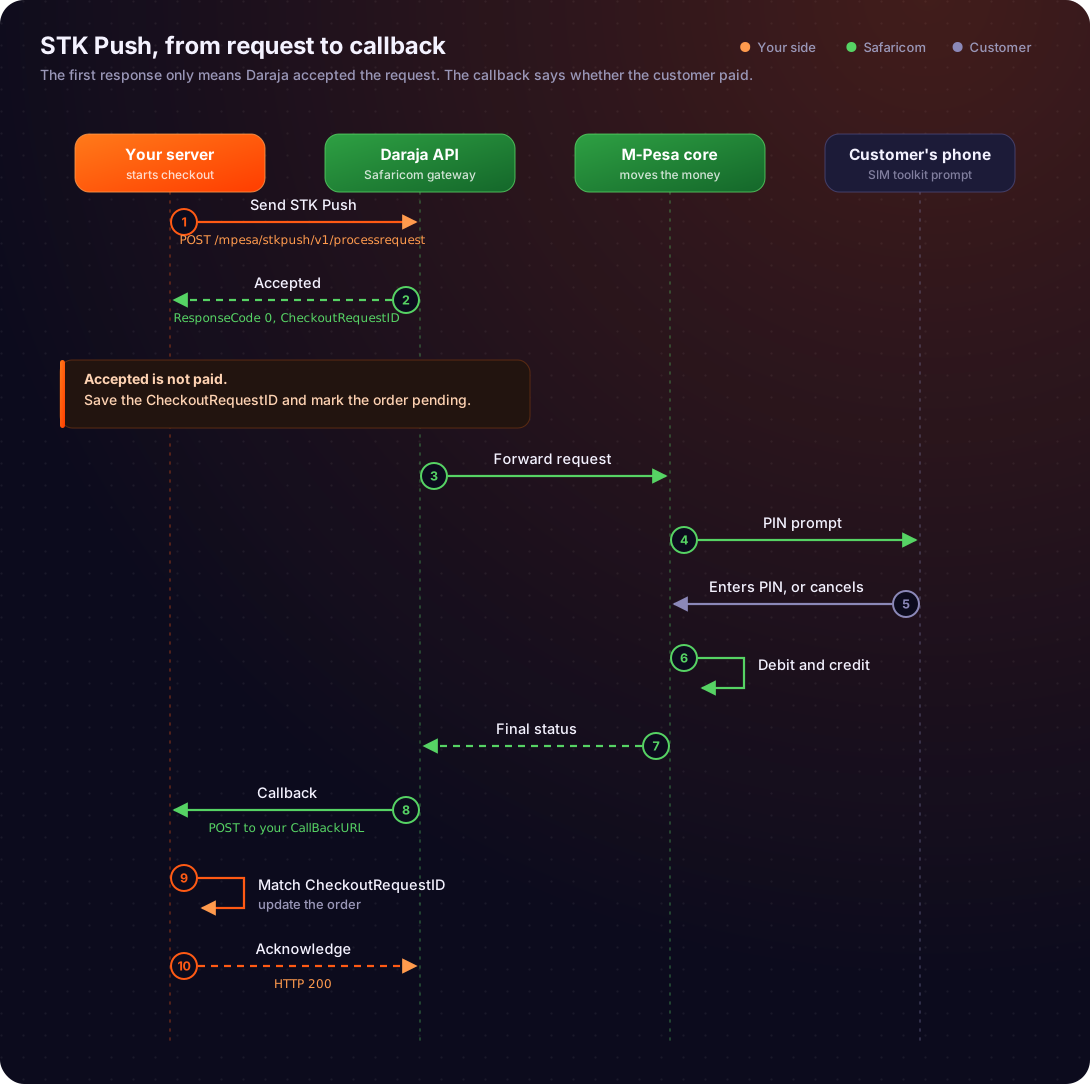
This diagram visually encapsulates the sequence of interactions, clearly distinguishing between the synchronous initial request and response, and the subsequent asynchronous callback mechanism. This asynchronous pattern is a foundational element of how Mpesa transactions are processed and confirmed.